How Precise Is CNC Machining for a Heat Sink?
- Yongxing
- 15 May ,2026
Many heat sinks fail because of poor flatness, weak fit, or unstable dimensions. These small errors can raise temperature fast and reduce product life in demanding systems.
CNC machining can achieve very tight tolerances for heat sinks, often within ±0.01 mm to ±0.05 mm depending on material, geometry, and machine setup. This high precision improves thermal contact, assembly accuracy, and long-term product reliability in critical applications.
Precision is one of the main reasons many industries choose CNC-machined heat sinks for aerospace, rail transit, EV systems, medical devices, and 5G equipment. A small machining error may look harmless at first. Yet in thermal management systems, even a tiny gap can increase thermal resistance and reduce cooling efficiency. Over the years, many customers have asked how much CNC precision really matters in heat sink production. The answer usually depends on the application, the heat load, and the assembly structure.
What tolerances can CNC achieve in heat sinks?
Small dimensional errors can create major assembly issues. Poor tolerance control may lead to loose mounting, thermal gaps, vibration problems, or unstable cooling during long-term operation.
Modern CNC machining can commonly achieve tolerances between ±0.01 mm and ±0.05 mm for heat sink components. Advanced CNC centers with stable fixtures and quality control systems can reach even tighter tolerances for critical thermal surfaces.
CNC machining has become one of the most trusted manufacturing methods for high-performance heat sinks because it offers repeatable dimensional control. In many industrial cooling projects, tolerance is not only about appearance. It directly affects heat transfer efficiency, assembly consistency, and long-term system reliability.
Why tolerance matters in heat sink production
Heat sinks usually connect with power modules, CPUs, IGBTs, batteries, or communication chips. These interfaces require strong surface contact. If the machining tolerance is unstable, the thermal interface material may not spread evenly. Air gaps may form between surfaces. This increases thermal resistance.
Many customers from Europe and Japan focus heavily on flatness tolerance. In some projects, the flatness requirement for the mounting base is below 0.03 mm. This level of precision helps maintain stable thermal conductivity across the entire contact area.
Typical CNC tolerances for different heat sink features
| Heat Sink Feature | Typical CNC Tolerance |
|---|---|
| Base flatness | ±0.01 mm to ±0.03 mm |
| Hole diameter | ±0.01 mm to ±0.02 mm |
| Fin spacing | ±0.03 mm to ±0.05 mm |
| Overall dimensions | ±0.05 mm |
| Threaded holes | ±0.02 mm |
| Surface roughness | Ra 0.8 to Ra 1.6 |
The actual tolerance depends on several factors:
- Material type
- Heat sink size
- Tool wear
- Machine rigidity
- Fixture design
- Cooling method
- Machining speed
Aluminum heat sinks are usually easier to machine with stable precision because aluminum has good machinability. Copper heat sinks are more difficult due to higher material softness and cutting resistance.
CNC machining vs other manufacturing methods
Extrusion is cost-effective for simple profiles. Die casting supports large volumes. However, CNC machining offers better dimensional precision for critical surfaces and complex structures.
CNC advantages include:
- Better flatness control
- Higher repeatability
- Flexible custom geometry
- Stable hole positioning
- Improved surface finish
This is why CNC machining is often used for prototype heat sinks, customized thermal modules, and high-power cooling systems where dimensional accuracy is critical.
In many projects, CNC machining also works together with skiving, extrusion, brazing, or friction stir welding. CNC becomes the final precision process that ensures all mating surfaces meet strict tolerance requirements before assembly and testing.
Does CNC accuracy affect thermal performance?
Some buyers only focus on heat sink size or material. Yet poor machining accuracy can quietly reduce cooling efficiency even when the thermal design looks correct on paper.
Yes, CNC accuracy strongly affects thermal performance because precise surfaces improve thermal contact, reduce interface resistance, and ensure even heat transfer between components and the heat sink.
Thermal management depends on more than just aluminum or copper conductivity. Heat must travel smoothly from the heat source into the heat sink. If the mating surface has poor flatness or uneven geometry, thermal transfer efficiency drops quickly.
The relationship between machining precision and thermal resistance
Heat always follows the path of least resistance. When surfaces are not flat enough, microscopic air gaps appear between the heat source and the heat sink base.
Air is a poor thermal conductor. Even with thermal grease or thermal pads, uneven surfaces can reduce heat transfer efficiency.
A highly machined flat surface helps:
- Increase contact area
- Reduce trapped air
- Improve thermal interface material distribution
- Lower contact thermal resistance
- Stabilize long-term cooling performance
This becomes very important in:
- EV battery cooling systems
- IGBT modules
- High-power LED systems
- Medical laser equipment
- 5G communication devices
Surface roughness also affects cooling
Flatness is only one part of CNC precision. Surface roughness also influences thermal transfer.
A smoother surface usually creates better contact between components. Many high-power applications require surface roughness below Ra 1.6 or even Ra 0.8.
Here is a simple comparison:
| Surface Condition | Thermal Contact Performance |
|---|---|
| Rough uneven surface | Higher thermal resistance |
| Moderate CNC finish | Stable heat transfer |
| Precision fine-machined surface | Lowest interface resistance |
In one past project involving rail transit power modules, the original supplier struggled with inconsistent thermal results. The base flatness varied too much between production batches. After improving CNC process control and tightening flatness tolerance, the thermal performance became much more stable during long-term testing.
Precision supports long-term reliability
Thermal systems operate under repeated heating and cooling cycles. Poor machining accuracy may create uneven pressure distribution during assembly.
This can cause:
- Warping
- Loosening
- Pump-out of thermal grease
- Mechanical stress concentration
Over time, these problems increase operating temperature and reduce component life.
Precision CNC machining helps maintain stable contact pressure across the interface surface. This improves reliability under vibration, thermal expansion, and harsh environments.
Many aerospace and semiconductor customers request detailed CNC inspection reports because they understand how closely machining precision connects to final thermal performance.
Which features require high machining precision?
Not every part of a heat sink needs ultra-tight tolerance. However, some critical areas directly affect thermal transfer, assembly strength, and structural reliability.
The most precision-critical heat sink features include mounting surfaces, threaded holes, fin spacing, interface flatness, and liquid cooling channels because these areas directly impact thermal efficiency and assembly stability.
Different heat sink applications require different levels of machining precision. A simple industrial cooling profile may allow wider tolerances. A liquid-cooled EV module may require extremely precise machining across several functional areas.
Mounting surfaces require the highest precision
The base contact area is usually the most critical surface in a heat sink.
This surface connects directly to:
- CPUs
- Power semiconductors
- IGBT modules
- MOSFETs
- Laser devices
- Battery modules
If the base surface is uneven, thermal contact resistance increases immediately.
For many high-power systems, the base flatness requirement stays within:
- 0.01 mm to 0.03 mm flatness
- Low surface roughness
- Stable parallelism
This precision allows uniform pressure distribution after assembly.
Threaded holes and mounting positions
Assembly alignment depends heavily on machining accuracy.
Poor hole positioning can cause:
- Assembly stress
- Misalignment
- Uneven clamping force
- Cracking risks
- Vibration instability
CNC machining provides repeatable positioning accuracy for threaded holes and mounting structures.
This becomes especially important in:
| Application | Precision Importance |
|---|---|
| Rail transit | Vibration resistance |
| Aerospace | Weight and structural reliability |
| Medical devices | Compact assembly precision |
| EV systems | Thermal cycling stability |
| Semiconductor equipment | Stable thermal contact |
Cooling fins and airflow structures
Fin geometry directly affects airflow performance.
Precision matters for:
- Fin thickness
- Fin spacing
- Parallelism
- Straightness
If fin spacing varies too much, airflow resistance changes. This may reduce cooling efficiency and create uneven airflow distribution.
In skived fin or CNC-machined fin structures, maintaining stable dimensions becomes critical for predictable thermal performance.
Liquid cooling channels
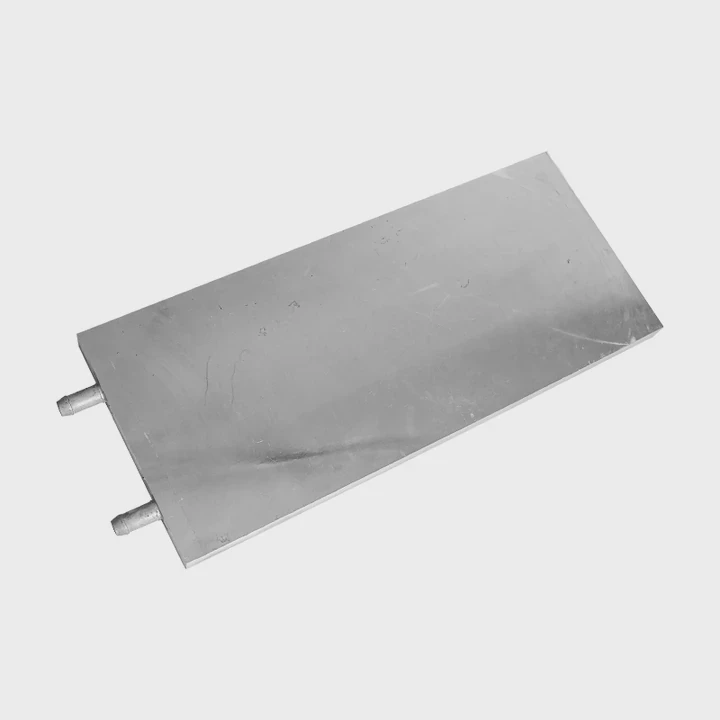
Liquid cold plates often require very high CNC precision because internal channels affect flow rate and pressure drop.
Critical areas include:
Channel dimensions
Small dimensional variation can change coolant flow behavior.
Sealing surfaces
Poor machining may create leakage risks after welding or assembly.
Welding interface zones
Friction stir welding and vacuum brazing require accurate mating geometry before joining processes begin.
In many liquid cooling projects, leak prevention depends heavily on CNC machining quality before final sealing.
Complex integrated structures
Modern heat sinks increasingly combine multiple functions:
- Structural support
- Cooling channels
- Mounting interfaces
- Embedded heat pipes
- Vapor chambers
As heat sink structures become more integrated, CNC precision becomes even more important because dimensional errors can affect several functions at once.
This is why many advanced thermal management projects include full dimensional inspection reports, CMM testing, and surface flatness analysis before shipment.
Can CNC reduce production errors for heat sinks?
Production inconsistency creates hidden risks in thermal systems. One unstable machining process can cause repeated assembly failures, thermal issues, and expensive customer complaints.
Yes, CNC machining significantly reduces production errors for heat sinks through automation, repeatable tool paths, stable dimensional control, and precise quality inspection systems.
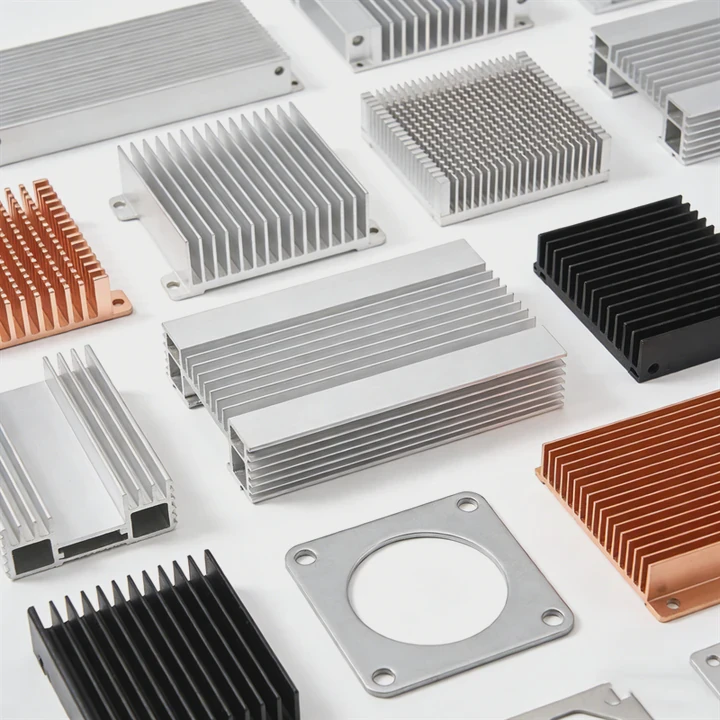
Production stability matters just as much as thermal performance. A heat sink may pass initial testing, but inconsistent production quality can create major problems during mass manufacturing.
CNC improves repeatability
Traditional manual machining depends heavily on operator experience. CNC machining uses programmed tool paths and automated movement control.
This creates:
- Stable dimensions
- Consistent hole positions
- Repeatable surface finish
- Controlled cutting depth
- Uniform production quality
Repeatability becomes extremely important for OEM and ODM heat sink projects where thousands of parts must maintain the same thermal behavior.
CNC reduces human error
Manual production methods often create variation between batches.
Common manual production risks include:
- Incorrect positioning
- Uneven cutting
- Tool setting mistakes
- Inconsistent measurement
- Surface damage
CNC systems minimize these issues through digital process control.
Inspection systems strengthen quality control
Modern CNC production usually includes advanced inspection equipment such as:
- Coordinate measuring machines (CMM)
- Surface roughness testers
- Flatness measurement tools
- Laser inspection systems
These inspection systems help identify dimensional deviation early before products move into final assembly.
CNC helps support traceability
Many industrial customers require complete production traceability.
CNC manufacturing systems can record:
- Machining parameters
- Production batches
- Tool life
- Inspection data
- Operator records
This helps solve quality issues much faster if problems appear later.
Stable machining improves long-term cooperation
Many buyers care more about consistency than extreme precision alone.
A supplier that produces stable quality every month usually creates fewer project risks.
In one long-term energy storage project, the customer originally faced repeated assembly problems from another supplier because hole alignment shifted slightly between batches. After switching to a more stable CNC-controlled process, assembly efficiency improved significantly and field failure rates dropped.
CNC supports complex custom projects
Modern heat sinks are no longer simple aluminum blocks. Many designs now include:
- Multi-layer assemblies
- Integrated liquid cooling
- Vapor chambers
- Complex airflow channels
- Hybrid welded structures
These designs require stable multi-axis machining and advanced process control.
CNC systems help manufacturers maintain dimensional consistency even with highly customized geometries.
For high-power industries, reducing production errors is not only about lowering scrap rates. It also protects product reliability, customer trust, and long-term system safety.
Conclusion
CNC machining gives heat sinks the precision needed for modern thermal management systems. Tight tolerances improve thermal contact, assembly stability, and long-term reliability while reducing production errors across demanding industrial applications.